
Direct Metal Laser Sintering - What it is + How it Works
Updated: Apr 22
Since its introduction in the mid-1990s, direct metal laser sintering technology has steadily grown into its current state, as an accepted alternative (and in many cases, an improvement) to traditional manufacturing methods. Direct metal laser sintering (also known as L-PBF) is an additive manufacturing method where fine layers of metal powder are repeatedly laid down and selectively melted by lasers to form complex metal parts.

Shown above is a photograph taken through the viewing glass of an EOS M-300-4 as it lases a single layer of powder. This particular print became 4 heat exchangers for an electric racecar.
Modern direct metal laser sintering printers are a complex combination of subsystems required for the printing process. The primary four subsystems are:
Mechanical: composed of the Recoater, Flexible Dispenser, Building Axis, and Exchangeable frame. These form the framework for the building process to occur.
Optical: includes the laser generating modules and laser scanning system. This system not only generates the laser power, but directs it to the metal feedstock in the process chamber.
Pneumatic: compressed air and inert gas systems are responsible for maintaining the production atmosphere and pneumatically controlled systems.
Electrical: controls all systems within the printer, including motor drives, PLC units, and laser modules.
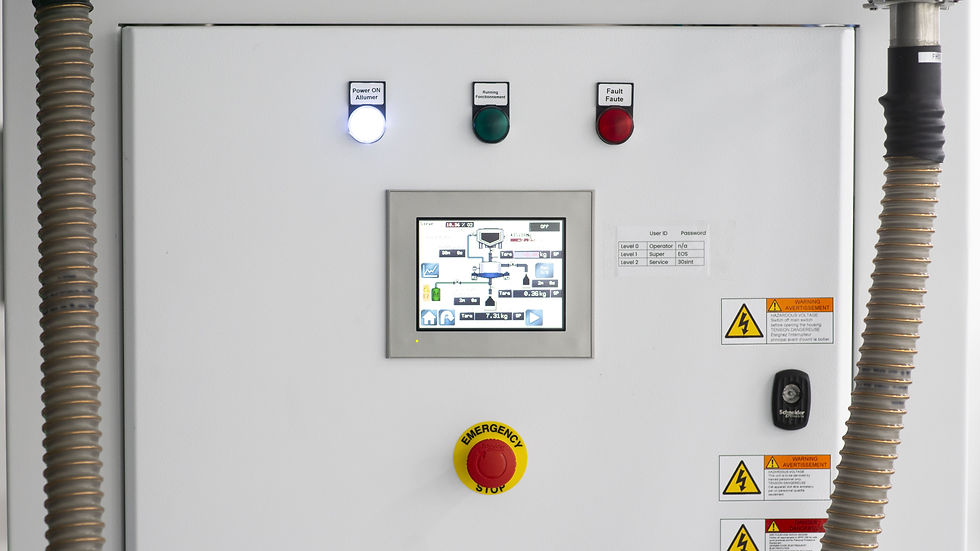
Here is an image of the side of an EOS M300 printer system. This monitor displays important metrics for powder conveying and sieving during printing. Though not technically a subsystem, the powder itself is an incredibly important and particular component of print success. All DMLS powder contains the desired metal along with additional binders to encourage clean sintering.
A direct metal laser sintering printer uses all four subsystems in tandem to grow parts within its build chamber. A simplified sequence of operations runs in this order:
The CAD model of the desired part is imported into a slicing program that interprets the model, recommends areas where the component may need extra support while printing, and slices the resulting form into layers that the machine can understand.
Metal powder stock is loaded into the machine’s dispenser, and build plate is installed.
The process chamber is flooded with inert gas to prevent oxidation, clear process byproducts, and create a clean, stable build environment. This allows for the reliable printing of metal alloys such as titanium, aluminum, stainless steel, Inconel, and copper.
An initial powder layer is spread onto the build plate by the recoater blade.
The build is started, and lasers precisely melt the first layer of the build onto the build plate.
Once lasing is completed on this layer, the build plate lowers the predetermined height of one layer (typically ~60µm).
The recoater then passes over the build, again laying a fine layer of metal powder.
Lasers fire and precisely melt the second layer of metal powder onto the first.
Steps 6-8 are then repeated thousands of times to grow the desired part in increments of ~60µm.

This is a very simplified graphic illustrating the sintering + recoating steps of the printing process (steps 5-8). Property of Rennscot MFG.
This process will repeat for the total number of layers required to produce the part(s). Once the build process is complete, the excess powder can be removed from around the parts, and sieved for future use. At this point, the parts are still attached to the build plate. Because of the inherent rapid melting and cooling process involved with direct metal laser sintering, it is typical for parts to undergo a stress relief heat treatment before being cut from the build plate. This heat treatment will remove inherent stress in the part while in a constrained state. Once removed from the build plate, the parts can continue with all post-processing operations, including support removal, media blasting, machining, cleaning, and final QC inspection.
In this short video you can see the EOS M300-4 in action as it performs one cycle of lasing and recoating.
As of November 2025, Rennscot MFG has four EOS DMLS additive manufacturing systems. These systems are currently producing parts in Ti6Al4V, AlSi10Mg, and 316L materials. What makes Rennscot MFG unique is not its line of printing systems, but the even larger machine shop operated by experienced programmers who can take printed parts to beautifully post-machined application-ready products. By having industry-leading additive and subtractive departments under one roof, Rennscot MFG is able to marry the design freedom, rapid production, and material efficiency of additive with the dimensional accuracy and surface finishes of subtractive.

Above is a photograph of a very unique build plate that shows the variety of geometries that L-PBF can create. Property of Rennscot MFG.
Whether you're developing next-gen electronics housings, flight ready hardware, or high-efficiency cooling systems, Rennscot MFG is ready to help you bring your vision to life.

